
Institute of Polymer Mechanics, University of Latvia – Scope of Some Research and Dissemination
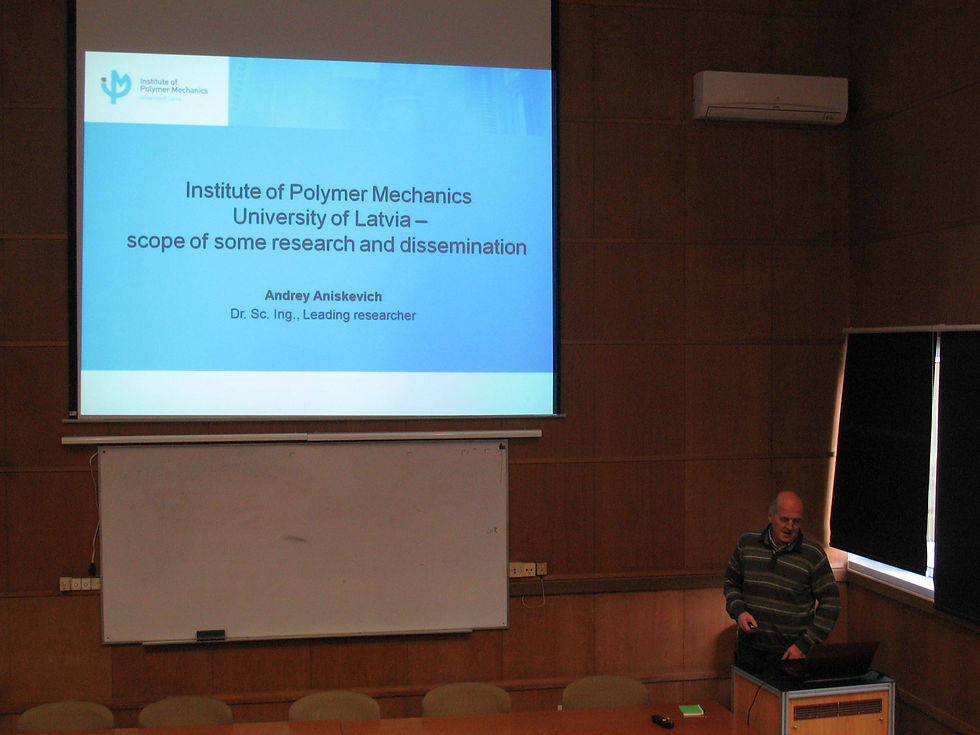
Dr. Andrei Aniskevich is the leading researcher of the Institute of Polymer Mechanics of the University of Latvia. Besides the outstanding research performed by the institute, it is also well known for the publication of Mechanics of Composite Materials and the organization of the International Conference of Mechanics of Composite Materials.
For any given material applied from aerospace to civil engineering structures each researcher at the institute has to answer three questions: “How do I make this material?” Technology is the answer. “How do I make this construction?” Design and modelling is the way. “How long will this construction last?” Durability and reliability is investigated.
The work of Dr. Andrei Aniskevich focuses mainly of fibre-reinforced plastics, dealing with their environmental effects and the prediction of long term deformability, having in mind that the materials produced should withstand several decades.
For this purpose, based on experimental data obtained over smaller timescales his team applies different models that allow to predict the longtime deformability of materials, also taking into account periodic environmental changes that modify the viscoelastic response of the materials due to adsorption of moisture which can last several months or even years.
A common area between his research and the SECoP research group is the development of self-healing materials. Nevertheless, as noted by Dr. João Tedim, different self-healing concepts are involved in the approaches used by the two research groups. Whereas in the SECoP research group nanocontainers added to the coating formulations release corrosion inhibitors upon an external trigger associated with corrosion forming a thin molecular layer over the metal, in the research group of Dr. Andrei Aniskevich an adequate composite with intrinsic, capsule based or vascular self-healing ability usually responds to a damage on the coating repairing the defects on micro- or even mesoscales.
The main topic of Dr. Andrei Aniskevich’s research related to the SMARCOAT project is the development of polymer composites with damage identification ability. One approach involves the microencapsulation of leuco dyes applied in the coatings together with a dye developer that jointly have the ability to locally change the coating color upon an external force on the material. This force releases the dye from the nanocontainers indicating the place of damage, allowing the easy and rapid inspection of potential critical damages on aeronautical structures, for example. The encapsulation methodology of dyes inside nanocontainers also crosses the work developed during the PhD of Frederico Maia on the SECoP research group (currently Head of R&D of Smallmatek), applied at the time for corrosion detection.
Some of the shortcomings concerning the self-healing and mechanical damage detection currently being addressed by Dr. Andrei Aniskevich’s group are the amount of self-healing or damage identification agent released from capsules upon a small impact, which might not be enough to heal small cracks or identify small damages that don’t destroy enough capsules to release the active substances.


Comentários